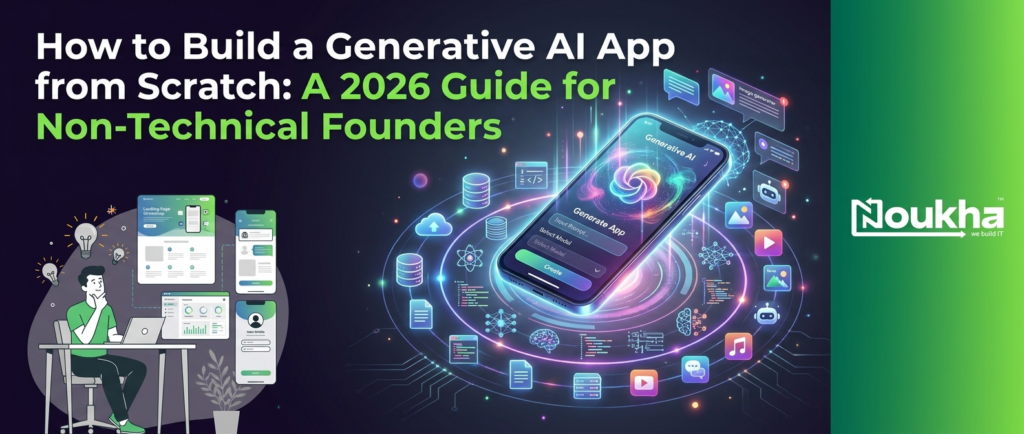
How to Build a Generative AI App from Scratch: A 2026 Guide for Non-Technical Founders
| Can a non-technical founder build a generative AI app in 2026?
Yes. Non-technical founders can build generative AI apps in 2026 by following a structured five-stage process: define the core use case, validate the concept with a prototype, select a development partner with AI experience, build and test iteratively, and launch with a feedback loop in place. The key is owning the product vision and business logic while working with a technical team for implementation. Many successful AI apps in 2026 were founded by domain experts with no coding background who partnered with specialized development firms. |
Table of Contents
- Why Non-Technical Founders Have a Real Advantage in AI
- The Five Stages of Building a Generative AI App
- Choosing Your AI Model and Architecture
- Working With a Development Partner: What to Expect
- Launch, Feedback, and Iteration
- Frequently Asked Questions
How to Build a Generative AI App from Scratch: A 2026 Guide for Non-Technical Founders
Introduction
One of the most important shifts in software development in 2026 is that technical skill is no longer the primary barrier to building an AI product. The barrier now is clarity of vision. Founders who understand a problem deeply, know their users intimately, and can define what success looks like have more to offer than a developer who can write code but does not know what to build.
Generative AI has made this more true than ever. The core models that power AI apps are available as APIs. Building on top of them requires thoughtful product design and strong domain knowledge, which is exactly where non-technical founders have an edge.
This guide walks you through building a generative AI app from scratch without writing a single line of code yourself. It covers every stage from initial concept to post-launch iteration, and is designed to give you the vocabulary and framework to work effectively with technical teams.
1. Why Non-Technical Founders Have a Real Advantage in AI
Most generative AI apps that fail do so for product reasons, not technical ones. The model did not understand the user’s intent. The interface created friction. The output was impressive but not actually useful. None of these are engineering failures. They are product failures.
Non-technical founders who come from the industries they are building for carry something genuinely rare: they know what the user actually needs. They have lived the problem. They understand why current solutions fall short.
That domain knowledge, when channeled into a clear product specification and a strong brief for a development team, is more valuable than the ability to write the code. The engineering is repeatable. The insight is not.
2. The Five Stages of Building a Generative AI App
| Stage | Name | What Happens | Your Deliverable |
| 1 | Define | Clarify the single core use case, the target user, and what a successful output looks like | Problem brief (1-2 pages) |
| 2 | Validate | Test the concept with 10 to 15 target users using a non-AI prototype or prompt-based demo | Validated user feedback |
| 3 | Partner | Select a development partner with AI integration experience and define scope and architecture | Signed SOW and project plan |
| 4 | Build | Iterative development in sprints with biweekly reviews; you review output, not code | Working beta application |
| 5 | Launch and Iterate | Release to a controlled user group, measure key metrics, and prioritize the first iteration roadmap | Live product plus v1.1 plan |
3. Choosing Your AI Model and Architecture
You do not need to choose the AI model yourself, but you need to understand enough to ask the right questions. Here are the three decisions your development partner will need your input on:
General-purpose vs. fine-tuned model
A general-purpose model can handle most text-based tasks without customization. If your app requires deep expertise in a specialized domain, such as specific legal frameworks or proprietary company data, you may need a fine-tuned model. Fine-tuning adds cost and time but significantly improves accuracy for niche applications.
Cloud API vs. on-device AI
Most AI apps call a cloud-based API for processing. This is simpler and delivers stronger performance. However, apps where privacy is critical increasingly use on-device AI that processes data locally without sending it to external servers.
RAG (Retrieval Augmented Generation)
If your app needs to generate outputs based on specific documents, databases, or proprietary content, a RAG architecture lets the AI retrieve relevant information before generating a response. This is particularly valuable for customer support apps, enterprise knowledge tools, and research applications.
4. Working With a Development Partner: What to Expect
Your role in this partnership is to be the voice of the user and the guardian of the product vision. Your development partner handles the technical implementation. Clear boundaries make the collaboration work.
- You write the product brief. This is the most important document in the project. It should define who the user is, what problem you are solving, what the app should and should not do, and what success metrics you will use.
- You participate in sprint reviews every two weeks. This is where your domain knowledge becomes critical: you can spot quickly whether the AI outputs are actually useful or subtly wrong.
- You own the prompt strategy. For generative AI apps, the instructions given to the AI model significantly affect output quality. You understand the domain well enough to iterate on these.
- You manage stakeholder feedback. As you move toward launch, gather feedback from beta users and channel it back to the development team in structured, prioritized form.
For founders who want a partner that handles everything from architecture design to launch, working with a team specializing in AI app development in India offers both cost efficiency and deep generative AI expertise. For founders targeting a US product launch specifically, an experienced AI app development company in the USA can bridge the gap between your product vision and US market expectations.
5. Launch, Feedback, and Iteration
The biggest mistake non-technical founders make after their app launches is treating it like a finished product. Generative AI apps are not finished at launch. The initial release is a learning instrument.
Build your feedback loop into the product from day one. Simple thumbs-up and thumbs-down ratings on AI outputs are more valuable than you might expect. They tell you exactly where the model is performing and where it needs work, without requiring users to write detailed feedback.
Set a 30-day and 90-day review cadence with your development partner where you assess usage data, error rates, and user feedback together. Prioritize the next iteration backlog based on what is actually causing friction, not what sounded good during planning.
Frequently Asked Questions
Q1. Do I need any technical knowledge to commission an AI app?
No, but a basic understanding of key concepts such as APIs, prompts, fine-tuning, and RAG will make your conversations with developers significantly more productive. You do not need to know how to build these things, but knowing what they are helps you ask informed questions.
Q2. How do I protect my app idea when sharing it with a development partner?
Use a mutual NDA before any substantive discussions. Include IP assignment clauses in your development agreement that transfer all work product to you upon payment. Most reputable firms are accustomed to these requirements and will sign without issue.
Q3. What is the minimum viable product for a generative AI app?
An MVP for a generative AI app is typically a single-workflow application that demonstrates the core AI capability clearly. If your app is an AI-powered contract reviewer, the MVP is the review function, cleanly presented, working reliably on representative documents. Nothing more.
Q4. How do I know if my app idea is suitable for generative AI?
Generative AI is well-suited to tasks involving text, content, summarization, question answering, classification, and creative generation. If your core use case involves any of these, generative AI is likely a good fit.
Q5. What ongoing costs should I expect after launching an AI app?
Expect API usage costs, hosting and infrastructure, ongoing maintenance and updates, and iteration development. For most early-stage apps, total ongoing costs run between $2,000 and $10,000 per month depending on usage volume.
Conclusion
Building a generative AI app in 2026 as a non-technical founder is not a workaround or a compromise. It is a legitimate path that produces better products when the founder’s domain knowledge is deep and their product instincts are sharp. The technology is accessible. The models are powerful. What is genuinely scarce is the clarity of vision that only comes from lived experience in an industry.
If you have that, find a development partner who can execute on it. Define the problem clearly, validate before you build, and treat launch as the beginning of the product journey rather than the end.
About the Author
| Ramanathan Alagappan
Founder and CEO, Noukha Technologies Ramanathan Alagappan is the Founder and CEO of Noukha Technologies. With 13+ years in product engineering and technology leadership, including CTO and senior engineering roles, he has a track record of building products from zero to one in SaaS and platform businesses. He works closely with founders and business leaders to translate product vision into AI-powered, production-ready systems, bridging the gap between business intent and technical execution. |
About Author